

Description
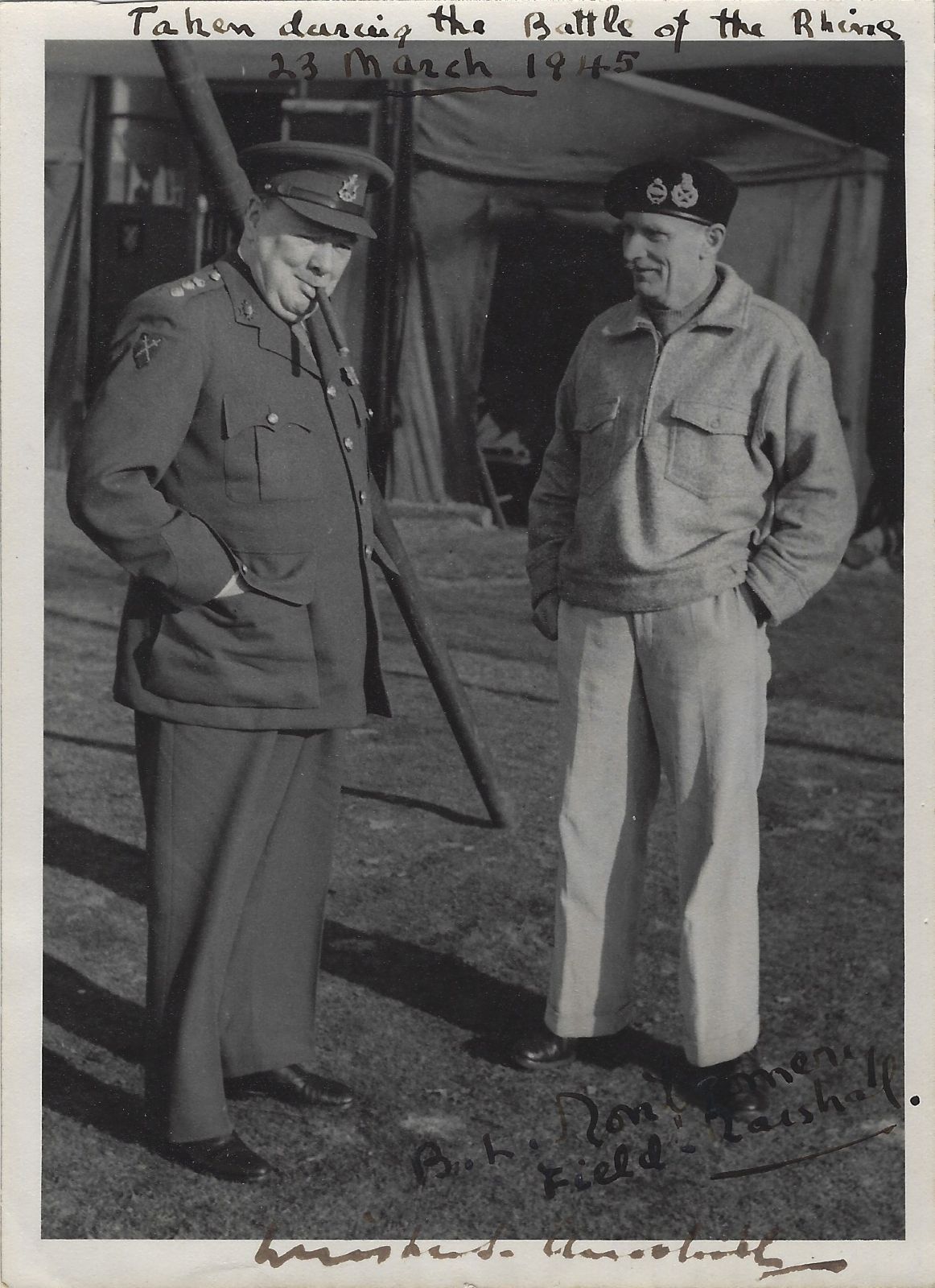
Churchill, Winston (1874 – 1965) & Montgomery of Alamein (1887 – 1976)
Rare dual-signed photograph of Churchill and Montgomery, pictured during Operation Plunder’s historic crossing of the Rhine river into German territory
An outstanding matte-finish 4.75″ x 6.5″ full-length photograph of Winston Churchill smoking a cigar standing beside Field Marshal Montgomery during Operation Plunder, signed along the lower border in fountain pen, ‘Winston S. Churchill’ and immediately above, ‘B. L. Montgomery, Field-Marshal’. Montgomery adds to the upper section, ‘Taken during the Battle of the Rhine, 23 March 1945.’ In very fine condition. This item originates from the estate of Montgomery of Alamein himself.
On the night of March 23rd 1945, the Allies launched Operation Plunder, the decisive assault to cross the Rhine and enter Germany. The operation was conducted by Field Marshal Sir Bernard Montgomery’s 21st Army Group, with crossings at Rees, Wesel, and south of the River Lippe by the British Second Army under Lieutenant General Miles Dempsey and the U.S. Ninth Army under Lieutenant General William H. Simpson. Planned by Montgomery as a massive, coordinated assault, the Battle of the Rhine combined a three-army advance, Operation Varsity airborne landings, a five-thousand-gun artillery barrage, and heavy Anglo-American bombing, supported by vast stockpiles of bridging equipment and supplies.
Prime Minister Winston Churchill was present at Montgomery’s headquarters near Venlo on the eve of the operation and, on March 24th, observed the Varsity airborne landings with Montgomery. The following day, Churchill accompanied Montgomery to General Dwight D. Eisenhower’s headquarters, where they received a briefing before moving to a sandbagged house overlooking the Rhine and a quiet stretch of the German-held east bank.
After Eisenhower’s departure, Churchill — accompanied by Montgomery, U.S. commanders and armed guards — insisted on crossing the river in an LCVP landing craft, landing for approximately 30 minutes in enemy territory without opposition. The party then visited the shattered railway bridge at Wesel, withdrawing only when German artillery began to range the area.
Churchill’s daring presence at the front underscored Allied confidence and symbolized the dramatic shift in momentum. The successful Rhine crossing marked the final major Allied push into Germany, with German defeat now clearly imminent. Churchill, noted for his insistence on being near the front lines, later remarked, ‘I never worry about action, but only inaction.’