

Description
Schiele, Egon (1890 – 1918)
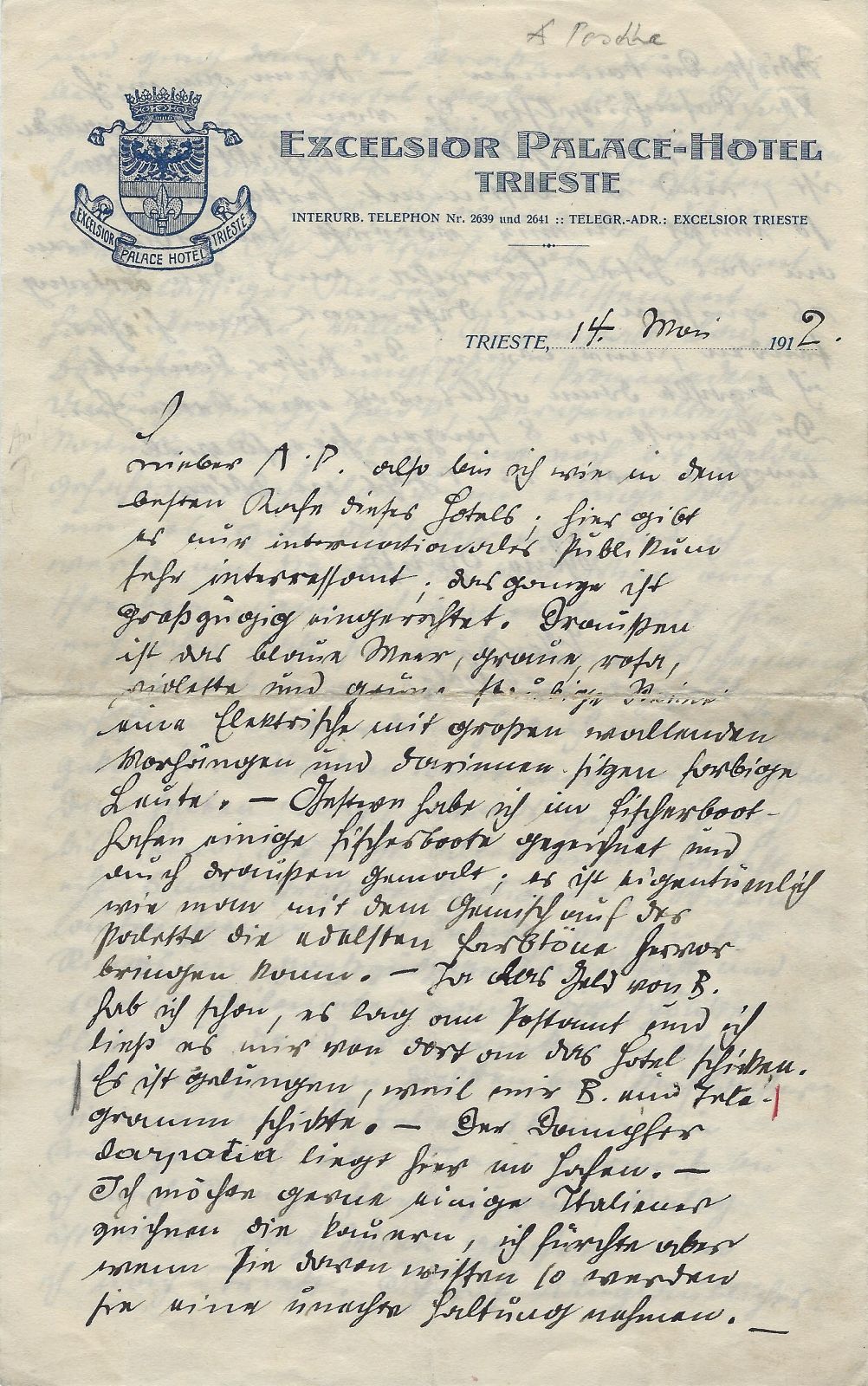
‘Outside is the blue sea, dusty stones in shades of grey, pink, violet… I would like to draw some Italians crouching, but I fear that if they sense me doing it, they will assume an inauthentic pose.’
An early and marvellous four-page autograph letter signed by Egon Schiele (‘Egon Schiele), 14th May 1912 on a single folded sheet of Excelsior Palace-Hotel, Trieste headed paper. Schiele writes an intimate and detailed letter, filled with painterly observations, to fellow artist Anton Peschka (‘A.P.’). Written approximately a week after Schiele was released from prison, where he’d been incarcerated for twenty-four days on charges of ‘immorality.’
Schiele opens with a flourish: ‘Dear A. P.! So, I am again in the best café in this hotel; it’s full of international guests, very interesting; the whole place is lavishly furnished. Outside is the blue sea, dusty stones in shades of grey, pink, violet and green, a tram with large, billowing curtains, and inside sit people of colour. Yesterday I sketched some fishing boats in the fishing boat harbour and also painted outside; it’s remarkable how one can produce the most exquisite shades with the mixture on the palette. Yes, I already have the money from B. [Heinrich Benesch], it was at the post office, and I had it sent from there to the hotel. It worked because B. sent me a telegram. The steamer Carpatia is here in the harbour. I would like to draw some Italians crouching, but I fear that if they sense me doing it, they will assume an inauthentic pose.’
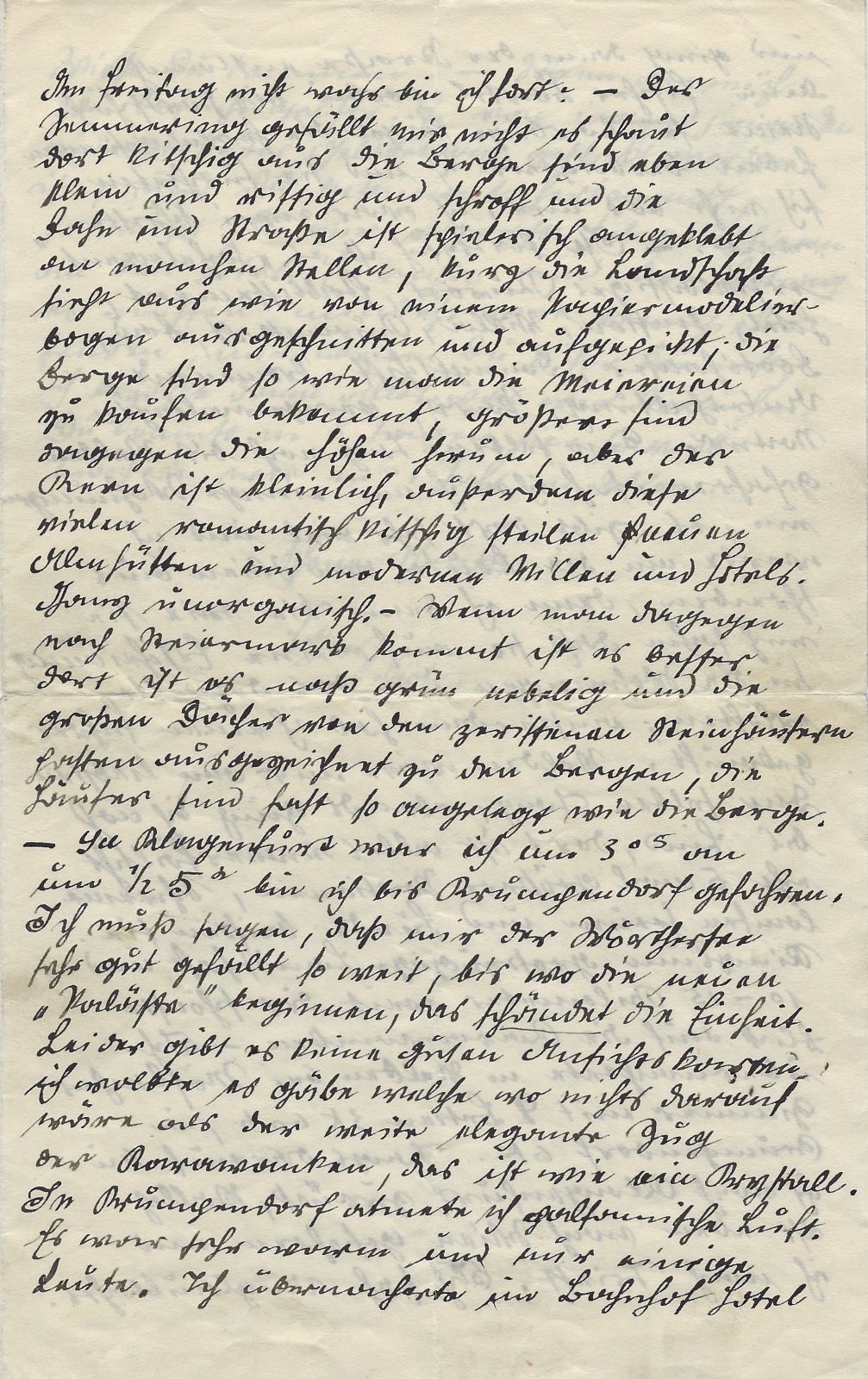
He continues, ‘I’m leaving on Friday, aren’t I? I don’t like Semmering; it looks kitschy there. The mountains are small, cracked, and rugged, and the railway and road are just haphazardly tacked on in places. In short, the landscape looks like it’s been cut out of a paper model kit and stuck together. The mountains are like the kind you buy at a dairy farm; the surrounding hills are bigger, but the core is petty, and then there are all those romantically kitschy, steep, new alpine huts and modern villas and hotels. Completely unorganized. It’s better when you go to Styria, on the other hand. There, it’s a wet, green, misty landscape, and the large roofs of the crumbling stone houses blend perfectly with the mountains; the houses are laid out almost like the mountains themselves. I arrived in Klagenfurt at 3:05 a.m., and by 4:30 a.m. I had driven to Krumpendorf. I must say that I really like Lake Wörthersee up to where the new “palaces” begin; they spoil the unity. Unfortunately, there aren’t any good postcards. I wish there were some that showed nothing but the vast, elegant expanse of the Karawanks – it’s like crystal. In Krumpendorf, I breathed in balmy air. It was very warm, and there were only a few people. I stayed overnight at the Bahnhof Hotel and then walked along the road past Bartel the fisherman’s to Pörtschach.’
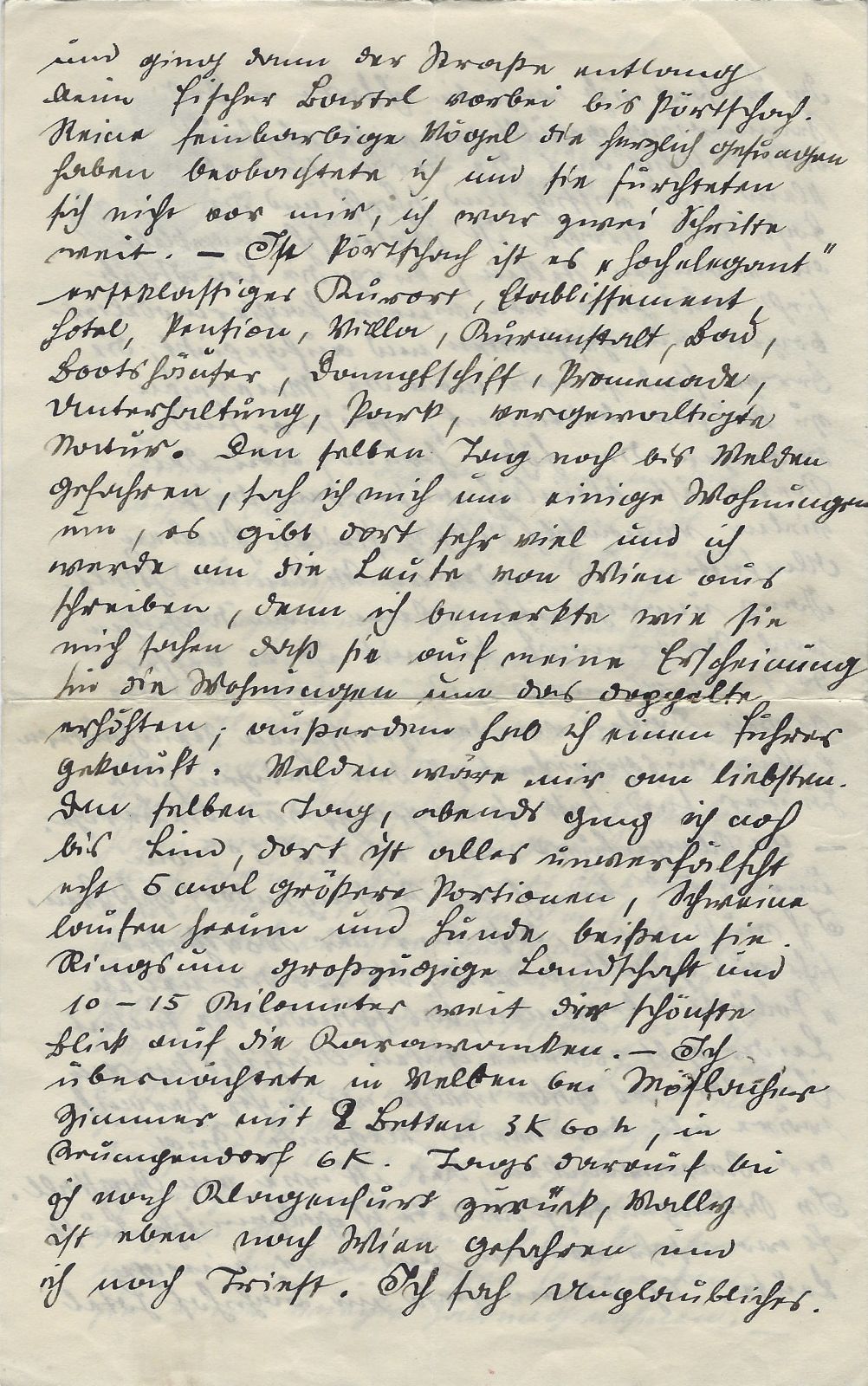
Schiele goes on, ‘I observed pure, delicately coloured birds singing heartily, and they weren’t afraid of me; I was only two steps away. In Pörtschach it’s “highly elegant,” a first-class spa resort, establishment, hotel, guesthouse, villa, health resort, bath, boathouses, steamboat, promenade, entertainment, park, violated nature. That same day I drove to Velden, looked around for some apartments; there are many there, and I will write to the people from Vienna, because I noticed how they saw me — that they doubled the price of the apartments upon my arrival. I also bought a guidebook. Velden would be my favourite. That same day, in the evening, I went to Lind, where everything is genuinely authentic, five times the portions, pigs roam around and dogs bite them.
All around, expansive countryside and for 10-15 kilometres the most beautiful view of the Karawanken mountains. I stayed overnight in Velden, at Möslacher’s, a room with two beds for 3 crowns, 60 euros, in Krumpendorf for 6 crowns. The next day I went back to Klagenfurt. Wally [Walburga „Wally“ Neuzil] just went to Vienna and I went to Trieste. I saw incredible things.’
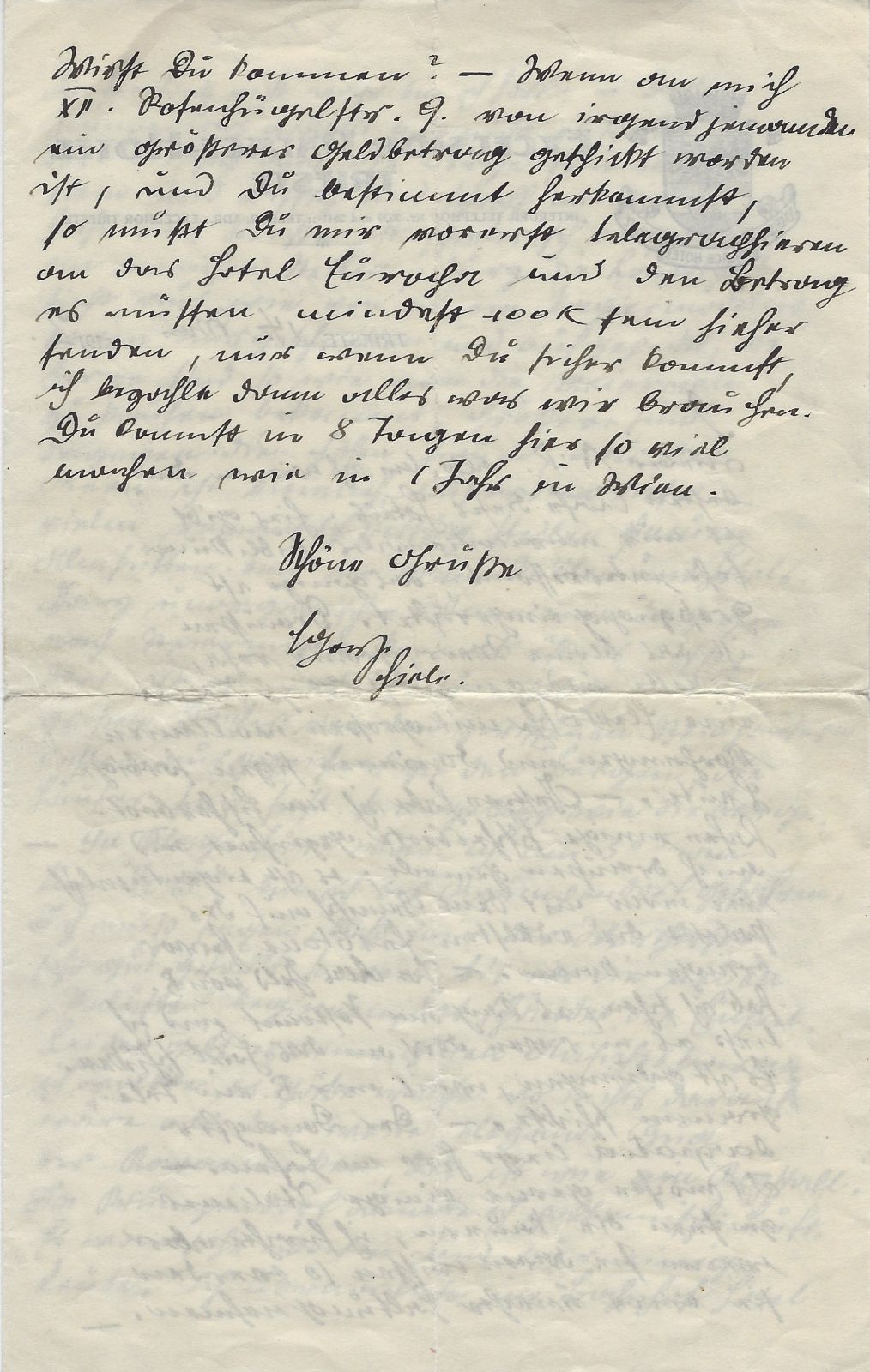
In closing, the artist writes, ‘Will you come? If a large sum of money has been sent to me at XII., Rosenhügelstr.[aße] 9 by anyone, and you are definitely coming, you must first telegraph me at the Hotel Europa and send the amount here. It must be at least 100 crowns. Only if you are sure to come, I will then pay for everything we need. You can accomplish as much in 8 days here as in 1 year in Vienna. Best regards, Egon Schiele.’
Letter folds, otherwise in very fine condition. Extremely rare and desirable in this format.
An unusually guarded and early letter from the artist. The exuberant prose can likely be directly linked to the recent release from prison, and newfound freedom. Of interest here, too, is Schiele’s anti-idealisation of the landscape, describing scenes as ‘kitsch’ or ‘cut out of a paper model kit’. A marvellous letter filled with insights seen through the young Schiele’s keen, painterly eyes.