

Description
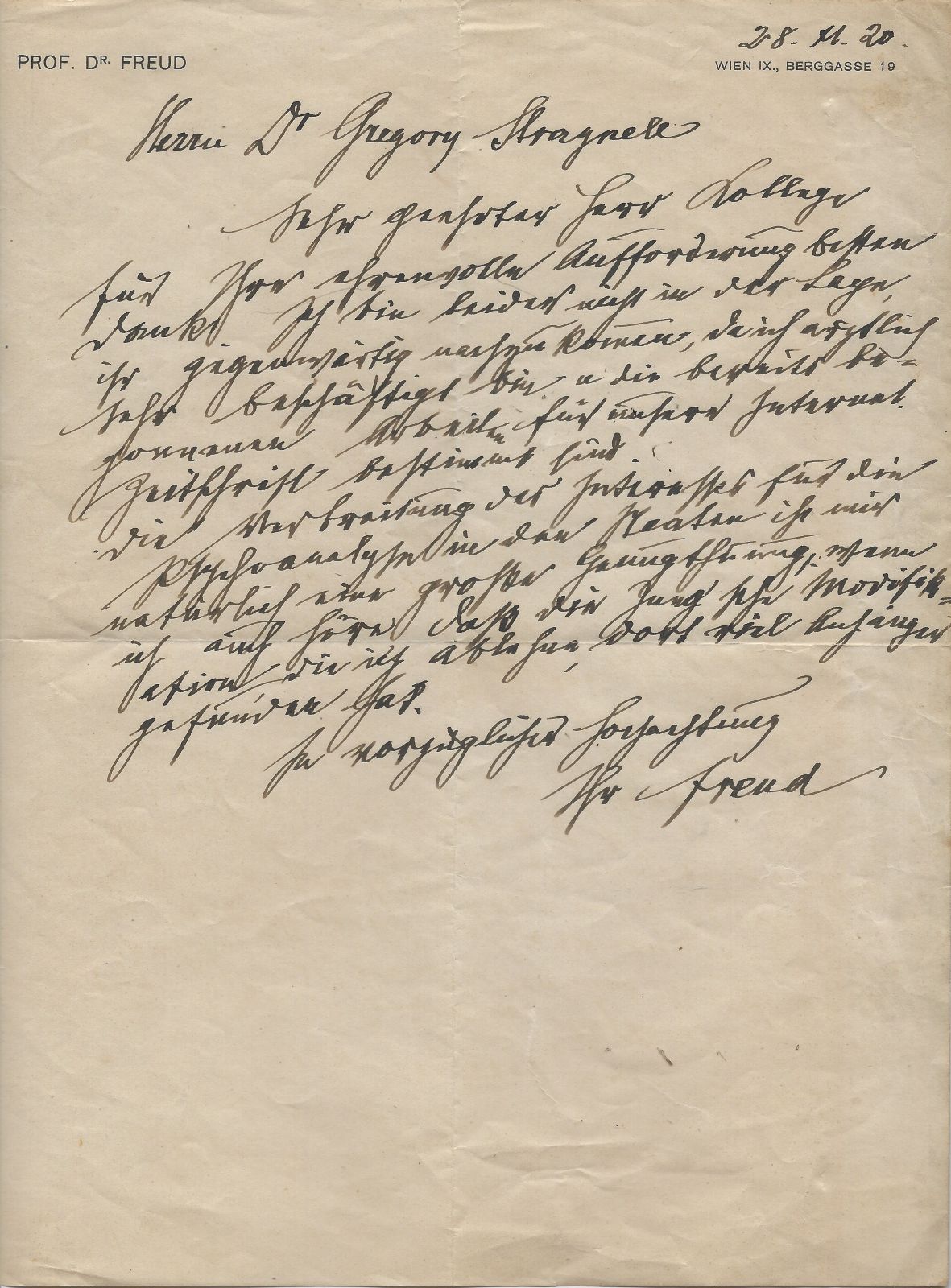
Freud, Sigmund (1856 – 1939)
On Carl Jung’s Growing Influence in America: ‘The Jungian modification, which I reject, has found many followers there’
An excellent autograph letter signed by Sigmund Freud, ‘Freud’, in German, November 28th 1920, to American neuropsychiatrist Dr. Gregory Stragnell, thanking his correspondent for a request concerning an article he is unfortunately unable to supply as he is excessively busy with his work. He goes on to explains that all his articles are now entrusted to the International Journal of Psychoanalysis: ‘Since I am very busy with my medical work and the work I have already started is intended for our intern. magazine.’ He continues, noting that he is very pleased to hear that his work is widely followed in America, although expressing dismay over the growing influence of Carl Jung and his establishment of analytical psychology. ‘I…hear that the Jungian modification, which I reject, has found many followers there.’ In generally fine condition, with two tears to folds: a small tear to the central fold at the top edge, and a longer tear to the central fold, right edge, both of which could be easily repaired. Letters of Freud that reference Jung, and their diverging intellectual paths, are extremely rare.
By 1920, Sigmund Freud’s disapproval of Carl Jung’s work had widened over the previous decade. Freud had originally seen Jung as his heir in the psychoanalytic movement, but their split (formalized around 1913) stemmed from Jung’s rejection of Freud’s emphasis on sexuality as the core of psychological motivation. Jung’s new ‘analytical psychology’ introduced ideas such as the collective unconscious, archetypes, and a more spiritual or mythological dimension to the psyche — concepts Freud considered unscientific and dangerous.
By the time of Freud’s 1920 letter, his own work had turned towards Beyond the Pleasure Principle (published the same year), in which he explored the death drive and reinforced his biologically grounded, drive-based model of the mind. Jung’s influence in America — where psychoanalysis was just beginning to gain traction — would have been particularly frustrating for Freud, who viewed Jung’s theories as a distortion of his carefully constructed scientific casework.
Dr. Gregory Stragnell (1888-1963) was a neuropsychiatrist who had a distinguished career as an editor of the Medical Record and as a member of the American Psychoanalytic Association.